
All questions about natural Henna and Jagua are below. If you are looking for Prices, Contact Form or how to choose your henna package, see links on Home page or menu tabs – or just click these links (underlined).
What is Henna?
Henna paste is made from the leaves of the Henna plant (varieties of Lawsonia) that grow in hot dry countries; the leaves have a natural brown to red dye depending on where it originated. The leaves are dried and ground to a fine powder, which is then sieved and sieved to make sure it’s as fine as possible. This is then mixed with warm water and anything acidic (such as lemon juice) to activate the dye release. Everyone has their own special recipe and add such ingredients as coffee, tea, ground flower blossoms and other herbs, etc. I find that keeping it as simple as possible gives the best stain. The paste is put into cones with a tiny hole at the end to ‘draw’ the designs (Mehndi).
Henna is therefore all natural and has no contraindications and is suitable for all ages; I mix a tiny amount of essential oils with my paste, so contact me if you have an allergy to a particular oil.
What is Black Henna? (unfortunately, its not Henna at all!)
Natural henna is never black! It gives reputable Henna Artists a bad name. Black henna is made from harmful chemicals (like PPD) that could burn a design on your skin and you could end up with a permanent scar. Just Google it. Research has shown that even if you don’t have a reaction, the chemicals are absorbed into your system and you can develop allergies when older, to simple products like soap and shampoo. If you leave natural henna paste on overnight and with my henna seal, you can achieve a dark design that looks beautiful on any skin tone.
Read this from a Henna Artist’s Blog: https://hennablogspot.com/letter-to-my-sisters-about-the-harms-of-black-henna
But if you do want it very dark, like a permanent tattoo – try my Jagua (see below). It is a safe alternative to so-called ‘Black’ Henna.
Which cones are best to buy?
It’s best to buy freshly made henna paste locally and shipped within 2 days, before it spoils. Unfortunately, ready-made cones you can buy cheaply are mixed with chemical box hair dyes, so you still get a stain even after weeks of transport and months of them lying in a shop. As with the black henna they can also irritate your skin. If henna develops a dark stain after less than an hour – it’s not genuine henna, just chemical dye.
Natural henna is good for the skin and you won’t feel anything except a slight tightening of the skin as the paste dries. If you feel anything like itching or burning wash it off immediately. It’s not natural henna.
So, it’s best to find a source of handmade natural henna, which is shipped within 2 days. It can be kept for months in a freezer until you need to use it. If i get enough enquiries I will start making my own to sell. Or you can learn to make your own paste (there are 100s of videos on the internet).
Why do they sell these chemical cones?
Because natural henna is best kept on the skin for 4-5 hours or even overnight. So they developed these quick-fix cones to get a design within 20 minutes, for those who don’t want to wait that long. I recommend not taking the risk and I cater for those who can wait. A quick internet search will show you horrendous photos of chemical henna designs burnt into skin. It gives reputable artists a bad name.
I buy my henna powder from India and have this year’s harvest shipped to me in air-tight pouches which I keep in the fridge until I need to use it.
Readymade cones flake off quickly and leave a stain, unlike natural fresh henna which needs to be on the skin for at least 4-5 hours and darkens over 24 hours. As natural henna paste spoils after 3 days (as it’s all organic ingredients) they have to add chemicals to readymade cones to preserve it for months. But they also add chemical dyes to ensure a dark stain. Unfortunately, there is no legislation around labelling, so it can say ‘natural henna’ or anything they want on cones. You can get fake anything nowadays, it’s the same with henna.
I use a lot of sugar in my natural henna paste (to retain moisture), so it won’t flake off, but will stick to the skin for hours, especially after I put a lemon and sugar seal on – I also add guar gum (a natural food thickener) to make it flexible – then you are good to move around and get on with your day. So it’s not a hardship to keep it on for a long time.
If I get enough interest, I will start selling my own freshly made cones. But there are many reputable sellers on Etsy that sell freshly made henna. Check their reviews.
How long should you keep the paste design on for?
As long as possible! – especially if you are over 40, when your skin starts to thin, or you have especially dry skin (the design will fade as your skin is shed).
Overnight is best if you want it to last over a week (like a traditional Indian bride). 4-5 hours is optimal. Teenagers can get away with 2 hours as their skin is a lot thicker, so more henna to absorb. But the longer you leave it, the longer the stain will last.
Henna is traditionally used on hands/feet = where your skin is thickest; areas further away will not be as dark because the skin is thinner. I always supply a henna seal to protect it and to stop it from drying out too quickly. You can wrap in tissue and then clingfilm and wear it to bed. Or I can supply a medical plaster wrap (Hypafix) to protect your mehndi.
How long will the design last for?
This depends on age (see above), skin type (less on dry skin because design is shed with the skin), how often you wash the area, go swimming, etc. Chlorine fades henna very quickly.
On average a henna design can last 5-10 days for most people. Some skins take henna very well and others do not (ie. if you are naturally a cold person, as henna prefers heat). Henna on the under and sides of the feet and the palms can last 3 weeks or more, as skin is much thicker there.
The longer you leave the henna paste design on your skin = the longer it will last and the darker it will become. If you cannot wait and want a very dark stain – have a Jagua tattoo (see below).
How does henna work?
The henna slowly seeps through the layers of skin over time, and then once removed, it oxidises (turns darker) with exposure to the air, over the next 2 days. Once the paste is off you are left with a bright orange design which gradually darkens over the next 24-48 hours. So it’s best to have your henna done 2 days before an event. (If it has developed into a dark stain after the paste has flaked off, it is NOT natural henna).
How do you remove the paste?
This is the fun part! You just pick it off! My paste sticks to the skin like glue. Henna doesn’t like water, so DO NOT WASH IT OFF WITH WATER. It interferes with the dye release. If there are some stubborn bits left over, just wipe them off with moisturiser on a tissue. It won’t flake off completely like the chemical pastes.
How do I keep my mehndi design as long as possible?
Use a cream or favourite oil (coconut, olive, etc) to cleanse and keep it moisturised – especially if you have dry skin. Henna doesn’t like water, it interferes with the dye release and oxidation process (darkening) for the first 24 hours. After that, the more you wash over the design the quicker it will fade. Put a barrier cream like vaseline over the design to repel the water and DO NOT go swimming. Chlorine will fade your design after one swim.
What is White Henna?
It is just a henna pattern made with a mix of regular school glue and white acrylic paint. It only lasts a day or two before peeling off. It’s called Henna only because it’s used to create henna style designs.
In Summary
So, keep it natural ladies – it’s a good excuse to act like a Princess for the day, while waiting for your henna to develop. Brides traditionally have the paste on over-night.
- The longer you keep the paste on for, the longer your design will last. At least 4-5 hours is recommended. The longer the better.
- Common sense will tell you that a natural organic product of leaves, lemon juice, sugar and oil cannot last more than 3 days before it spoils.
- A reputable henna artist will make up a fresh paste for each job, or freeze until needed.
Feel free to message me with your questions.
STAY SAFE SISTERS.
Namaste
Thank you.
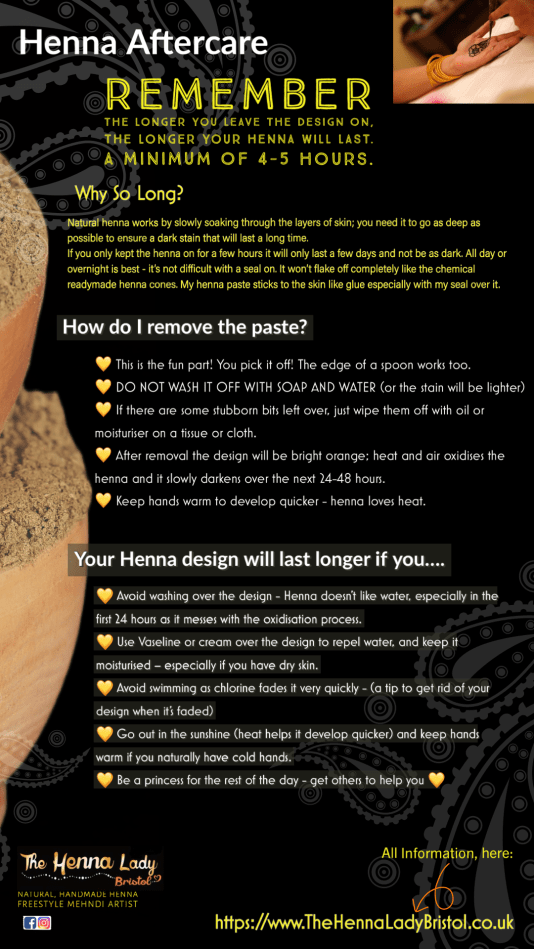
AFTERCARE FOR YOUR HENNA
How to Make Your Design Last as Long as Possible
- The only way to guarantee a long-lasting dark design is to keep the paste on for as long as possible – 4-6 hours min, or overnight if you have a dark skin tone or are over 40-years old (when our skin gets thinner)
- Remove paste by scraping with a spoon, fingernail, etc.
Remove any stubborn bits with oil (olive, coconut, etc., or moisturing cream) - DO NOT USE WATER TO REMOVE the paste.
- The Design will be bright orange – at this stage water interferes with the oxidation process
- Avoid washing over the design as much as possible – use Vaseline over the design to protect it from water; wash around your design
- Keep the area moisturised with your favourite cream or oil
- AVOID SWIMMING – chlorine stops the development and removes the design quicker
(this is a tip for removing last traces of your design when it fades)
So….
- The longer you leave the design on, the longer the stain will last (at least 4 hours) – think of each extra hour as an extra day your design will last
- The more you avoid washing over your design the longer it will last
- When design fades, remove by going swimming, or adding bicarbonate of soda to your favourite hand wash and gently rubbing away
ALL ABOUT JAGUA?
Jagua is another natural plant dye and used as a safe alternative to chemical ‘black henna’ – which we know now is not henna at all and very bad for the skin!
Usually Jagua is extracted from the sap of a fruit tree which is not suitable for those with a Tropical Fruit allergy. To be safe for everyone, I make my Jagua from an Asian species of the Gardenia flower; dried, powdered and mixed with water and gum to make a gel.
It reacts with the collagen in your skin to create a blue/black stain that looks like a permanent tattoo. It is most suitable for mature skin and darker skin tones. Unlike henna, which needs thicker skin to absorb through for a dark stain (the reason why it works best on younger skin),and needs to be kept on the skin for a long time – Jagua works quickly on anyone.
IT IS A NATURAL ALTERNATIVE TO THE CHEMICAL READY-MADE ‘BLACK’ HENNA CONES.
AFTERCARE FOR YOUR JAGUA DESIGN
Once you have had your Jagua design and it has dried, you are good to go. It is flexible and you can move around – but don’t touch it, rub it, or brush against it. Its dye is more potent than henna and hardly noticeable – so it is easy to transfer it to another part of your body by accident. Make sure you wash your other hand regularly just in case.
Leave it on for at least an hour to ensure it will last a couple of weeks. But it starts to stain after 20 mins. Please be aware that Jagua stains very easily – if you accidentally touch it, wash your hands immediately, or you will have a blue stain on other parts of your body! – Even if you can’t see anything!
I once did a design on a friend’s leg in the summer. She accidently put one leg over the other without thinking and the next day had part of the design on the other leg!
Never wipe it off before it has dried – you will end up with a smudged blue mark an hour later!
Let it flake off, or pick off any bits left. Then wash your hands immediately.
You might think it hasn’t worked, as your design is very faint or invisible…..don’t be fooled… it’s there.
Wait…..and after an hour or so you will start to see it get darker. When you wake in the morning – pop, you have a dark blue tattoo that darkens further over the next 24-48 hours.
Keep away from chlorine, bleach, and harsh cleaning products. Wash around the design and it will last longer.
The same as with henna, as it fades use a little baking soda mixed with hand wash and use this paste to gently rub away the last of the design.
If you want to get rid of it quicker (you smudged it etc) then use a little bleach or peroxide on a cotton pad. Dab the design and rub very gently a few times a day. It will be gone in two days.
 The Henna Lady Bristol